

The Clean Energy Jobs Plan outlines the UK government’s comprehensive strategy to capitalise on the economic potential of the clean energy transition and create hundreds of thousands of high-quality jobs nationwide by 2030. Rooted in the Clean Energy Superpower Mission, the plan outlines how investment in renewable energy, carbon capture, nuclear and energy efficiency will drive job creation in every region and nation of the UK. It details the scale of workforce growth needed, doubling from 440,000 to 860,000 jobs, and identifies priority sectors and occupations, from engineers and electricians to planners and welders. The plan also commits to ensuring these are “good jobs,” with fair pay, union representation, and career progression, while supporting existing workers in transitioning from carbon-intensive industries. Through targeted funding, new technical colleges, regional skills initiatives, and reforms to employment and education systems, the government aims to build a resilient, inclusive, and future-ready clean energy workforce that powers both net-zero and economic renewal.
Top 10 occupational groups by the increase in UK clean energy workforce required to 2030 (direct jobs only)
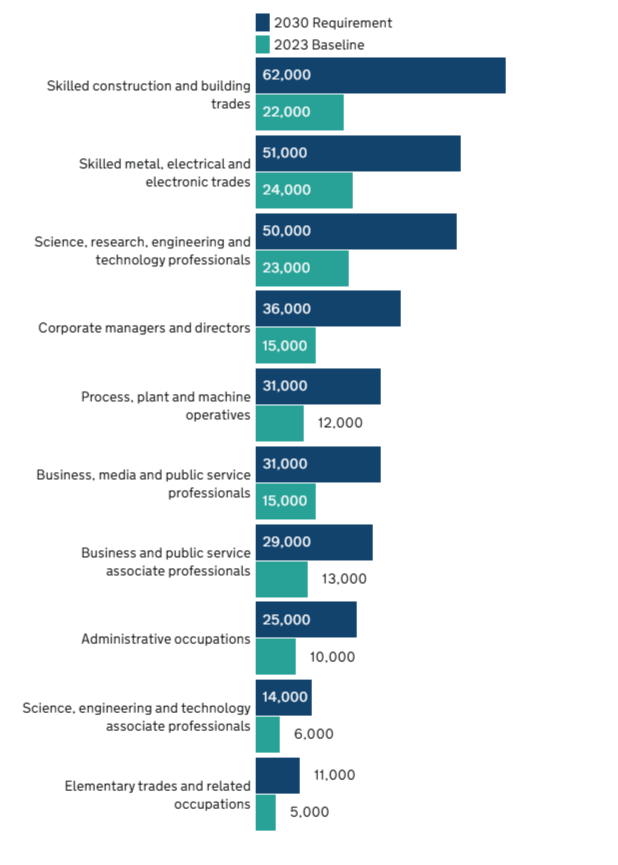
Source: Experimental DESNZ analysis of ONS Low Carbon and Renewable Energy Economy Estimates, ONS Annual Population survey and DESNZ workforce projections.
Clean Energy Jobs & Net Zero: Key Opportunities
Scale and Growth of the Workforce
- Clean energy jobs are expected to nearly double from 440,000 in 2023 to 860,000 by 2030.
- This includes direct and indirect roles across clean energy generation, transmission, distribution and efficiency.
- Growth is projected at ~10% annually, driven by investments and deployments across various sectors.
Sector-Specific Job Creation
- Major sectors include: offshore/onshore wind, solar, nuclear, hydrogen, carbon capture, heat pumps, smart systems and energy efficiency.
- The construction of Sizewell C (nuclear) and carbon capture projects, such as Acorn and Viking, could support tens of thousands of jobs.
- Clean power jobs (a subset) are vital to achieving Clean Power 2030 goals.
Quality and Accessibility of Jobs
- Clean energy roles offer higher-than-average pay (e.g., £50,000+ in wind, nuclear, networks vs. UK average of £37,000).
- Entry-level green jobs offer a 23% pay premium in many sectors, making them attractive to young people and career switchers.
- These jobs are resilient to automation and economic downturns.
- The government aims to ensure jobs are unionised, inclusive and locally accessible.
Skills Development and Transition Support
- £1.2 billion/year invested in skills, plus £100 million for engineering skills packages.
- 5 new Clean Energy Technical Excellence Colleges to train local workforces.
- Expansion of the Energy Skills Passport to help workers transition from carbon-intensive sectors.
- Targeted support for veterans, North Sea workers and regional interventions in Cheshire, Lincolnshire and Pembrokeshire.
Regional and National Impact
- Jobs will be distributed across all UK regions, with tailored local workforce plans.
- Scotland could see jobs nearly triple; Wales, Northern Ireland, and English regions could see a doubling of jobs.
- Local Net Zero Hubs and Skills Forums will coordinate regional efforts.
Collaboration and Governance
- The Office for Clean Energy Jobs (OCEJ) leads coordination across government, industry and unions.
- Trade union recognition and collective bargaining are promoted to improve job quality.
- Workforce criteria will be embedded in grants and procurement to ensure fair work standards
The Clean Energy Jobs Plan marks a turning point, not just for Britain’s energy future, but for its workforce. With bold investment, inclusive opportunity and a clear commitment to good jobs, the UK is poised to lead the global clean energy transition and ensure that every community shares in its success.
To find out more detail about the plan please follow this link:
https://www.gov.uk/government/publications/clean-energy-jobs-plan/clean-energy-jobs-plan-html